

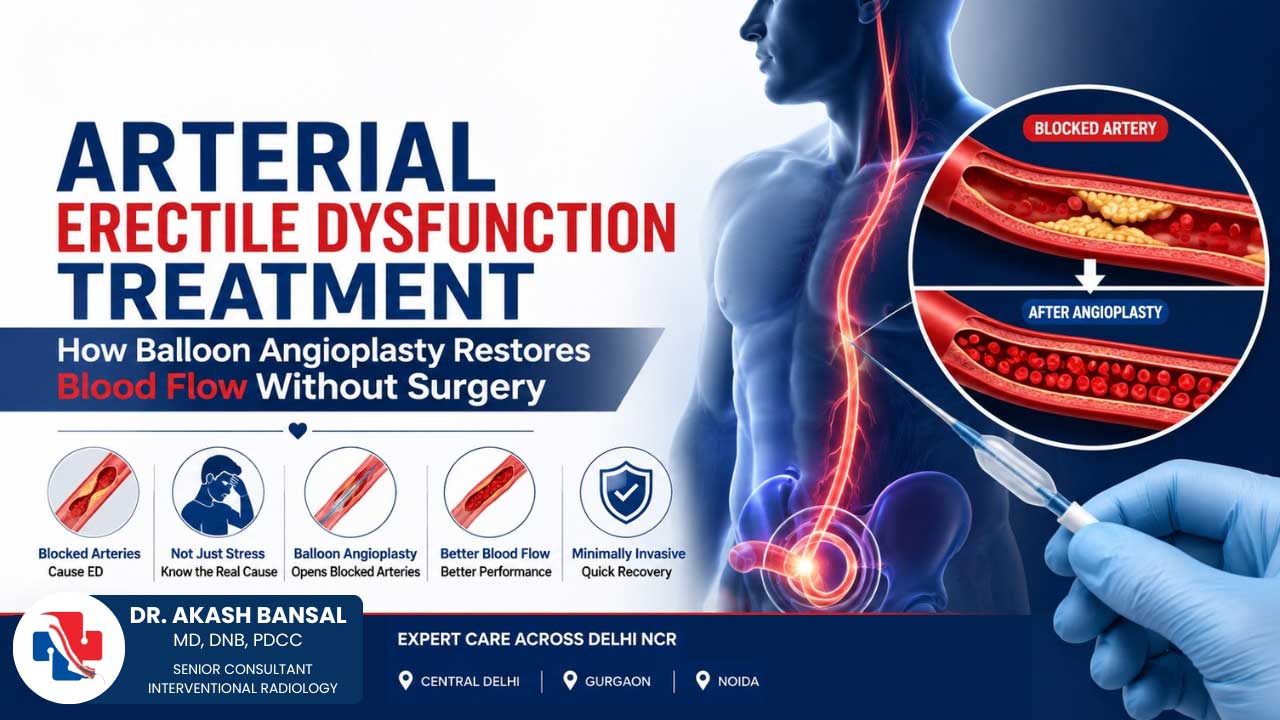
Arterial Erectile Dysfunction Treatment: How Balloon Angioplasty Restores Blood Flow Without Surgery
A patient walked into my clinic a few months ago, mid-fifties, and admitted something most men take years to say out loud. His tablets had stopped working, and the spark he once had had faded. He assumed it was age. He assumed it was stress. What he didn’t know: the real problem was sitting inside his arteries, not his head.
Erectile dysfunction caused by blocked arteries is one of the most under-diagnosed conditions in men over 40. Most men, and many doctors, reach straight for a tablet without asking why blood flow slowed down. As an interventional radiologist, I see ED due to poor blood flow as an early warning sign of wider vascular disease, appearing years before a heart attack or stroke.
This blog is for men who’ve tried the pills or been told “it’s just stress.” Here’s what arterial erectile dysfunction treatment in Delhi NCR actually looks like.
What Is Arterial Erectile Dysfunction?
Let’s start with the basics, because most men have never had this explained to them properly.
An erection isn’t really a muscular event it’s a plumbing event. When a man is aroused, nerve signals trigger the release of nitric oxide in the penile tissue, which relaxes the smooth muscle inside two spongy chambers called the corpora cavernosa. That relaxation lets blood rush in and fill the chambers, creating firmness. For this entire process to work, one thing has to be true: the arteries carrying blood to the penis need to be open, wide, and healthy.
Arterial erectile dysfunction happens when they aren’t.
Also known as vascular erectile dysfunction, this is a specific category of ED where the actual cause is restricted or blocked blood flow through the arteries that supply the penis, rather than a hormonal, psychological, or neurological issue. Think of it as a traffic jam upstream. No matter how willing the body is, if the road carrying blood is narrowed by plaque, the destination never receives enough supply to create or sustain an erection.
Understanding the Anatomy: How Blood Actually Reaches the Penis
To understand why this happens, it helps to know the route blood takes. It travels from the heart through the pelvic arteries, into a vessel called the internal pudendal artery, which further branches into smaller arteries, including the cavernosal artery, that directly feed the erectile tissue. These vessels are remarkably small, often just one to two millimetres wide, which is part of why they’re so vulnerable to blockage. A narrowing that a man wouldn’t even notice in a larger artery elsewhere in the body can be enough to choke off blood flow here.
When plaque builds up along these artery walls, a process called atherosclerosis, the vessel loses its ability to widen properly during arousal the clinical picture doctors refer to as arterial insufficiency erectile dysfunction. Over time, the inner lining of the artery, known as the endothelium, also stops functioning the way it should. This is called endothelial dysfunction, and it reduces the artery’s natural ability to relax and generate enough nitric oxide on demand. Between the physical narrowing and the loss of healthy vessel signalling, erectile function becomes compromised long before a man ever reaches for a tablet.
This is precisely why an effective arterial erectile dysfunction treatment needs to address the blood vessel itself, not just mask the symptom. In the field of vascular medicine, this specific presentation is often described as erectile dysfunction due to atherosclerosis a mouthful of a term that simply means plaque, not stress or age alone, is the root cause.
Who Needs Balloon Angioplasty for Arterial Erectile Dysfunction?
Not every man with ED has a blocked artery, and not every man with a blocked artery needs a procedure. So who actually fits this picture?
In my practice, I typically start suspecting blocked arteries causing ED in men who describe a specific pattern: the problem came on gradually rather than suddenly, oral medications that used to work no longer do the job, and there’s no obvious psychological trigger such as relationship stress or anxiety. This slow, physical decline is often the fingerprint of a penile artery blockage rather than a purely situational issue.
A few clues tend to show up together in men dealing with vascular erectile dysfunction:
- Men over 40, particularly those with diabetes, high blood pressure, high cholesterol, or a history of smoking
- Men who’ve noticed weaker morning erections, or firmness that keeps declining month after month
- Men who respond only partially to PDE5 inhibitors like sildenafil or tadalafil, or who used to respond well and have stopped responding
- Men already diagnosed with cardiovascular disease, Peripheral Artery Disease (PAD), or coronary artery disease elsewhere in the body
- Men whose ED appeared alongside leg cramping, fatigue on walking, or other signs of blood vessel related ED throughout the body
Here’s something worth sitting with. Erectile dysfunction caused by blocked arteries often shows up three to five years before a cardiac event in the same patient. The penile arteries are smaller in diameter than the coronary arteries, so they tend to clog first and effectively act as an early warning system. When a man in his 40s or 50s comes to me with unexplained ED, I’m not just thinking about his sex life. I’m thinking about his heart.
Balloon angioplasty becomes a realistic option once imaging confirms that the erectile dysfunction is genuinely arterial in origin, meaning a focused, treatable narrowing has actually been identified in the pudendal or cavernosal arteries, rather than the problem stemming from nerve damage, hormonal imbalance, a venous leak, or a psychological cause. This is why a proper diagnosis always comes before any conversation about intervention.
How Balloon Angioplasty for Arterial Erectile Dysfunction Works
Before we ever talk about treatment, we talk about diagnosis. I never recommend a procedure without first confirming that the artery is genuinely the problem.
Step 1: Confirming the Diagnosis
We usually begin with a penile Doppler ultrasound, sometimes called a penile duplex ultrasound, which uses sound waves to measure how well blood is flowing into the penis during an induced erection. This painless, non-invasive scan tells us whether blood flow is genuinely restricted, and roughly where the problem sits. If the ultrasound suggests arterial insufficiency, we move to penile angiography, a more detailed, image-guided study where a contrast dye is injected into the arteries so we can map exactly where the narrowing is on a live X-ray. This is the same category of imaging used to diagnose blockages anywhere else in the vascular system, and it’s what allows us to plan the procedure with precision.
Step 2: The Procedure Itself
Once a treatable blockage is confirmed, penile artery angioplasty is carried out as an outpatient, image-guided procedure. No general anaesthesia, no scalpel, no stitches.
Here’s what actually happens in the room:
- A tiny puncture, usually in the groin or wrist, gives us access to the arterial system. Local anaesthesia is used, so you’re awake and comfortable throughout.
- Using continuous X-ray guidance, I thread a thin catheter, a flexible tube barely wider than a strand of spaghetti, through the pelvic arteries and down toward the internal pudendal and cavernosal arteries.
- Once the catheter reaches the narrowed segment, a tiny balloon at its tip is gently inflated. This compresses the plaque against the artery wall and reopens the channel, restoring the natural diameter of the vessel.
- The balloon is deflated and withdrawn, blood flow is checked in real time with a repeat angiogram, and the catheter is removed. A small dressing is placed over the puncture site, no stitches required.
This entire approach falls under what’s called endovascular therapy, or catheter-based erectile dysfunction treatment a form of endovascular treatment for ED that works from inside the blood vessel rather than cutting through skin and tissue to reach it. The whole point is restoring penile blood flow using the artery’s own natural pathway, guided entirely by real-time imaging.
Most procedures take somewhere between 45 minutes and just over an hour, depending on how many arterial segments need attention, and patients typically go home the very same day.
Benefits of Balloon Angioplasty for Erectile Dysfunction
For the right patient, the appeal of this approach goes well beyond convenience.
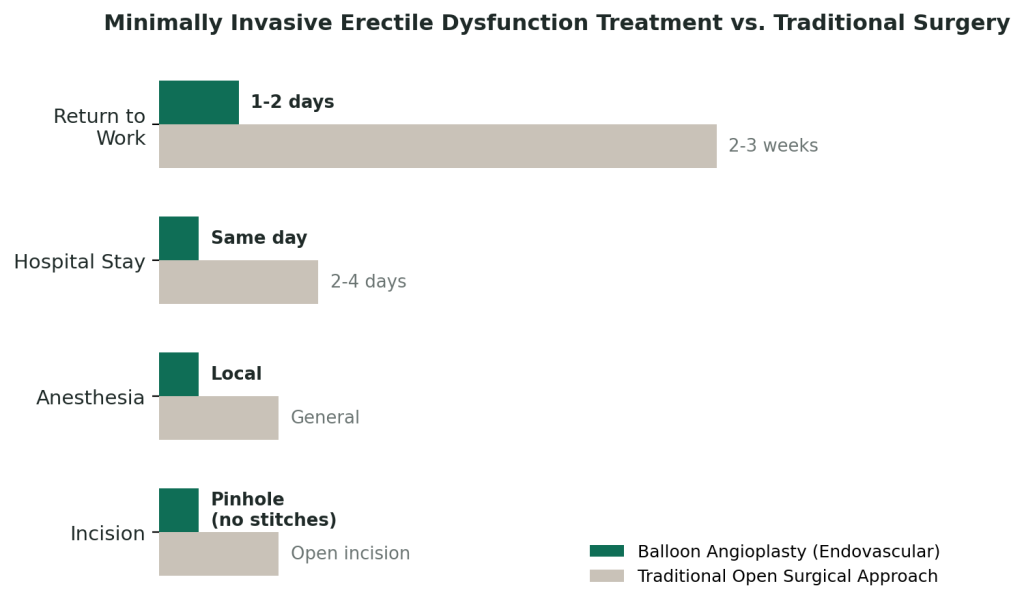
Balloon angioplasty for ED is, first and foremost, a minimally invasive erectile dysfunction treatment. There’s no cutting, no general anaesthesia, and no weeks of recovery to plan around. For a man who has spent years assuming surgery was the only “real” option, it’s genuinely an erectile dysfunction treatment without surgery, using a pinhole-sized access point instead of an incision. As an image-guided treatment for erectile dysfunction, every step is visualised on a screen in real time, which means the artery is treated with a level of precision that’s difficult to achieve any other way. For men who’ve long assumed the only serious options were “take a pill forever” or “go under the knife,” this middle path, erectile dysfunction without surgery, often comes as a genuine relief.
Because it’s an endovascular treatment for ED, it also directly addresses the physical cause rather than working around it the way oral medication does. Tablets like sildenafil work by enhancing the effect of nitric oxide in tissue that already has adequate blood supply but if the artery itself is blocked, there often isn’t enough blood reaching the tissue for the tablet to work well, if at all. This penile blood flow treatment, and more broadly any blood flow treatment for ED that targets the artery itself, aims to fix the actual supply line rather than just work around it.
| Benefit | Why It Matters |
| Non-surgical ED treatment | No incision, no general anaesthesia, no hospital admission in most cases |
| Same-day discharge | Most patients walk out within a few hours of the procedure |
| Targets the root cause | Directly treats the narrowed artery instead of only managing symptoms |
| Preserves natural function | Restores the body’s own blood flow rather than relying on external aids |
| Minimal downtime | Most men resume normal activity within one to two days |
| Repeatable if needed | Can often be redone on the same or a different arterial segment if narrowing recurs |
It’s worth being honest here: this is a vascular treatment for erectile dysfunction, not a guaranteed cure for every form of ED. It works specifically on the arterial cause. But for men whose poor blood circulation and erectile dysfunction has become a vascular issue rather than a psychological one, treating the actual blood flow problem, instead of simply working around it, is often the most logical and durable path forward.
Risks and Possible Complications
I believe patients deserve the full picture, not just the encouraging parts. Balloon angioplasty is a well-established interventional radiology technique with a strong safety profile, but like any medical procedure, it isn’t entirely risk-free.
The most common issues are minor: mild bruising or tenderness at the puncture site, which usually settles within a few days, and occasional discomfort during the procedure itself, managed with local anaesthesia. Less commonly, the artery wall can develop a small dissection (a minor tear) during balloon inflation, which we monitor closely and which usually heals on its own. There’s a small risk of an allergic reaction to the contrast dye used during imaging, which is why we always review your medical history beforehand.
The most important risk to understand isn’t really a complication in the traditional sense it’s restenosis, meaning the artery can narrow again over time in some patients, since these vessels are extremely small and the underlying atherosclerosis is a chronic condition, not something that’s “cured” in a single sitting. This is why ongoing risk-factor control (blood sugar, blood pressure, cholesterol, and smoking cessation) matters just as much as the procedure itself.
As a vascular specialist, my job isn’t to convince every patient that this is right for them. It’s to look honestly at your scans, your history, and your goals, and tell you where balloon angioplasty genuinely fits and where it doesn’t.
Recovery After Balloon Angioplasty
One of the things patients are consistently surprised by is how uneventful the recovery actually is.
Because this is a minimally invasive vascular procedure done through a pinhole-sized access point, there’s no surgical wound to heal. Most men are up and walking within an hour or two of the procedure, and are discharged the same day once we’ve confirmed the puncture site is stable.
Here’s a general timeline for recovery after penile artery angioplasty, though your doctor will tailor this to your specific case:
| Timeline | What to Expect |
| Day 0 (Procedure Day) | Rest at home, keep the puncture site clean and dry, avoid heavy lifting |
| Day 1-2 | Most men resume light daily activity and desk-based work; mild bruising is normal |
| Day 3-7 | Gradual return to normal physical activity, including light exercise, as advised |
| 2-4 Weeks | Sexual activity typically resumed once healing and follow-up are confirmed |
| 6-8 Weeks | Follow-up penile Doppler ultrasound to assess blood flow and artery patency |
There are no stitches to remove and no drains to manage. The biggest instruction I give patients is simple: don’t skip the follow-up scan, because that’s how we confirm the treatment is holding, and how we catch early narrowing before it becomes symptomatic again.
Success Rate of Balloon Angioplasty for Arterial Erectile Dysfunction
I’d rather give you real numbers than vague reassurance, because this is a decision that deserves honesty.
Published research on penile angioplasty, including prospective studies tracking outcomes with the IIEF-5 erectile function questionnaire, shows that the procedure itself is technically successful in reopening the artery in the vast majority of cases, often reported above 90% at the time of the procedure. The angioplasty success rate for clinically meaningful improvement in erectile function tends to be highest in the first few months afterward, generally reported in the range of 65-75% of appropriately selected patients, and settles to roughly 55-60% at the one-year mark as some arteries narrow again over time. This pattern, seen across studies on erectile dysfunction and vascular disease, is exactly why we treat this as a chronic vascular condition to be managed, not a single problem to be switched off.
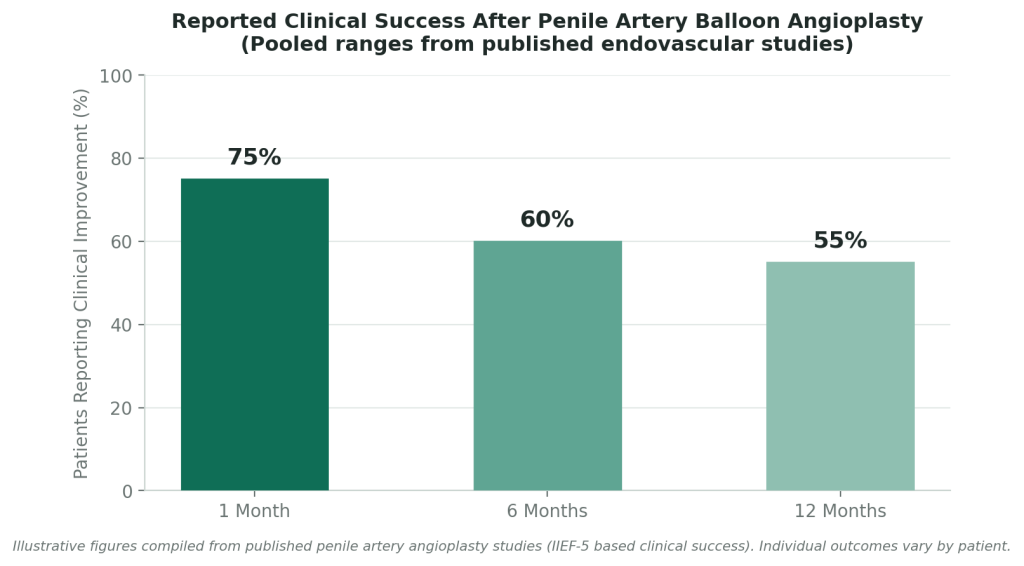
Figures compiled from published penile artery angioplasty studies using the IIEF-5 clinical scoring system. Individual outcomes vary by patient and severity.
What these numbers really tell us is two things. First, that arterial erectile dysfunction treatment through angioplasty and vascular disease outcomes are closely linked men with well-controlled diabetes, blood pressure, and cholesterol tend to hold their results for longer, because the underlying atherosclerosis is kept in check. Second, that this isn’t a “fit and forget” fix; it’s a genuine medical treatment with a real, measurable success rate, not a miracle cure and not a scam either.
I always tell patients the same thing: your individual result depends on how localised the blockage is, how small or diffuse the disease is across the artery, and how well the risk factors are managed afterward. A focused, isolated blockage in an otherwise healthy artery responds far better than diffuse disease scattered across a small, already-fragile vessel.
Who Is a Good Candidate?
Balloon angioplasty tends to work best in a fairly specific group of men, and part of my job is helping patients understand honestly whether they fall into it.
Good candidates typically have:
- A confirmed, localised narrowing on penile Doppler or angiography, rather than widespread, diffuse arterial disease
- Erectile dysfunction linked to identifiable vascular causes of erectile dysfunction, such as atherosclerosis, rather than primarily hormonal or psychological causes
- Reasonable overall cardiovascular health, since this is fundamentally a blood vessel related ED treatment and the same arteries need to support the rest of the procedure safely
- A history of partial or diminishing response to oral ED medication, suggesting the blood supply itself needs attention
- Willingness to manage underlying risk factors like diabetes, smoking, cholesterol, and blood pressure alongside the procedure, since these directly affect long-term durability
Men with very diffuse, widespread arterial disease, active uncontrolled infection, certain bleeding disorders, or ED that’s clearly linked to a different cause entirely, such as low testosterone or a venous leak, may need a different treatment path, and I’ll always say so honestly during your consultation rather than pushing a procedure that isn’t the right fit.
A Quick Note on Related Vascular Conditions
Arterial erectile dysfunction rarely exists in isolation. If you’ve already been diagnosed with Peripheral Artery Disease (PAD), are managing Diabetic Foot complications, or have a history of Deep Vein Thrombosis (DVT) or Varicose Veins, it’s worth mentioning this during your consultation, since these all point to the same underlying vascular health picture. Our clinic also offers a full range of Angiography & Angioplasty and Limb Salvage Procedures for related arterial conditions, along with Uterine Fibroid Embolization and Prostate Artery Embolization for other minimally invasive, image-guided treatments under the broader umbrella of Interventional Radiology and vascular disease treatment.
Frequently Asked Questions
Can blocked arteries cause erectile dysfunction?
Yes. The penile arteries are among the smallest in the body, which makes them especially sensitive to plaque build-up. When they narrow, blood flow to the erectile tissue drops, and this is a well-recognised cause of arterial erectile dysfunction, particularly in men with diabetes, high cholesterol, or a smoking history.
Is balloon angioplasty effective for ED?
For men whose ED is genuinely caused by a localised arterial blockage, published studies show meaningful improvement in a majority of appropriately selected patients, especially in the months immediately following the procedure. It isn’t a universal fix for all forms of ED, which is why accurate diagnosis matters so much beforehand.
Who is a candidate for angioplasty for erectile dysfunction?
Men with a confirmed, localised narrowing on penile Doppler ultrasound or angiography, whose ED has a vascular rather than purely hormonal, neurological, or psychological cause, are generally the best candidates. A consultation with imaging is the only way to know for certain.
Can angioplasty cure erectile dysfunction?
It can significantly improve blood flow and erectile function in men whose ED is arterial in origin, but it isn’t guaranteed to be permanent, since the underlying arterial disease can slowly progress again over time. Ongoing management of blood pressure, sugar, and cholesterol helps sustain results.
How long does recovery take after penile artery angioplasty?
Most men resume light activity within a day or two and normal activity within a week. Sexual activity is typically resumed within two to four weeks, once your doctor confirms the puncture site has healed and reviews your progress.
What is the success rate of balloon angioplasty for erectile dysfunction?
Technical success in reopening the artery is reported above 90% in published studies. Meaningful clinical improvement in erectile function is generally seen in around 65-75% of well-selected patients in the first few months, settling closer to 55-60% at the one-year mark.
Is balloon angioplasty better than ED medications?
They’re not really competing treatments; they work differently. Medications enhance the effect of nitric oxide in tissue that already has blood supply, while angioplasty restores the supply itself. For men whose ED is vascular and who respond poorly to medication, angioplasty addresses a cause that tablets simply can’t fix.
What tests diagnose arterial erectile dysfunction?
Diagnosis usually starts with a penile Doppler or penile duplex ultrasound to measure blood flow, followed by penile angiography if a treatable blockage is suspected. Your doctor may also review cardiovascular risk factors, since arterial ED often reflects vascular health elsewhere in the body.
Is penile artery angioplasty safe?
It’s considered a safe, well-established interventional radiology procedure with a low complication rate. Most risks are minor, such as bruising at the puncture site, though your interventional radiologist in delhi will review your individual history to confirm suitability.
Can poor blood circulation cause erectile dysfunction?
Yes. Erections depend entirely on adequate blood flow into the penile tissue, so any condition that restricts circulation, including atherosclerosis, diabetes, or peripheral artery disease, can directly contribute to erectile dysfunction.
Angioplasty for Male Sexual Health: The Bottom Line
If there’s one thing I want every man reading this to take away, it’s that erectile dysfunction is rarely “just in your head,” and it’s rarely something to quietly accept as an inevitable part of getting older. When the cause is arterial, it deserves an arterial solution, not just a tablet that works around the real problem.
Balloon angioplasty won’t be the right answer for every man, and I’ll tell you honestly if it isn’t for you but for the right candidate, it’s often the best treatment for arterial erectile dysfunction available today, precisely because it treats the artery instead of masking the symptom.
If you’re based in Delhi NCR and searching for an interventional radiologist in Delhi who treats arterial erectile dysfunction with the same precision and honesty we’d want for our own families, I’d encourage you to book a consultation. We’ll start with proper imaging, talk through what it shows in plain language, and figure out together whether this is genuinely the right path for you.
| Take the first step toward understanding the real cause, not just managing the symptom.
Dr. Akash Bansal · Consultant Interventional Radiologist · BLK-MAX Superspeciality Hospital, Pusa Road, Rajendra Place, New Delhi 110006 Book an Appointment: drakashintervention.com/book-an-appointment |
Disclaimer: This blog is intended for informational purposes only and does not constitute medical advice. Erectile dysfunction can have multiple causes, and only a qualified healthcare professional can determine the right diagnosis and treatment plan for your individual case. Please consult an interventional radiologist or vascular specialist for a personalised evaluation.