

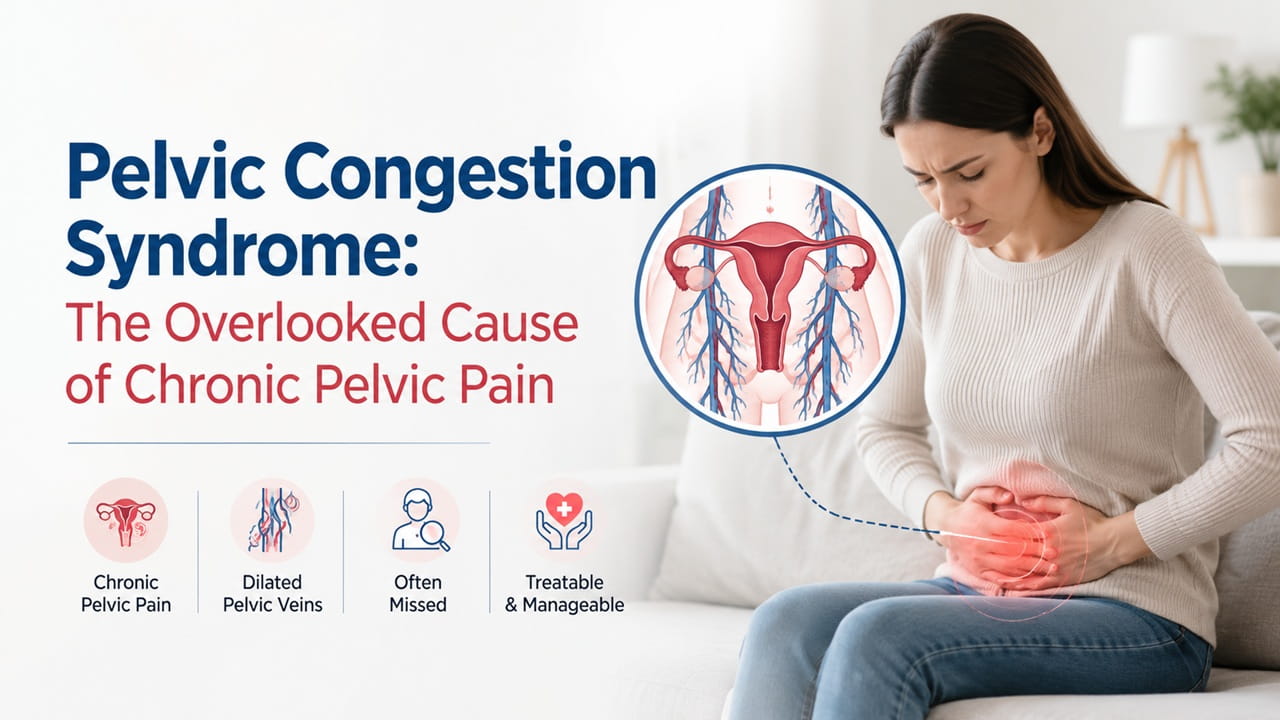
If you’ve been dealing with pelvic pain for months, been through scans that came back “normal,” and still don’t have an answer, it can be exhausting. Chronic pelvic pain has many possible causes, and getting to the right one often takes a thorough, patient evaluation. Pelvic congestion syndrome (PCS) is one condition that’s frequently missed in this process, an often-overlooked potential cause of chronic pelvic pain, rooted not in the reproductive organs themselves but in the veins that drain them.
This article explains what pelvic congestion syndrome is, what causes it, how it’s diagnosed, and how pelvic vein embolization is used to treat it so you have some context if this condition comes up in your own evaluation.
What Is Pelvic Congestion Syndrome?
Pelvic congestion syndrome, also called pelvic venous insufficiency or pelvic venous congestion, happens when the veins that drain blood from the pelvis particularly the ovarian veins and internal iliac veins stop working properly. Instead of blood flowing efficiently out of the pelvis, it pools and backs up, causing the veins to become enlarged and engorged, similar to varicose veins in the legs. This is sometimes referred to as pelvic venous reflux, and the enlarged, congested veins are known as pelvic varices.
This condition mostly affects women of reproductive age, particularly those who have had more than one pregnancy, since pregnancy increases pelvic vein pressure and volume. Estimates suggest pelvic congestion syndrome is present in a meaningful proportion of women being evaluated for chronic pelvic pain, yet it remains widely underdiagnosed, in part because standard imaging like a regular ultrasound doesn’t always identify it.
What Causes Pelvic Congestion Syndrome?
At the core of pelvic congestion syndrome is venous reflux a failure of the one-way valves inside the pelvic veins that are supposed to keep blood moving toward the heart. When these valves don’t close properly, blood flows backward and pools in the pelvis.
Several factors are thought to contribute:
- Pregnancy, which significantly increases blood volume and pressure in pelvic veins, and can permanently stretch and weaken them
- Hormonal factors, since estrogen can affect vein wall tone and dilation
- Anatomical variations, such as the left ovarian vein’s angle of drainage, which is similar in principle to why varicoceles more often affect the left side in men
- Compression syndromes, where one vein is compressed by a nearby artery, increasing pressure and reflux further downstream
The result is chronically congested, dilated veins around the ovaries and uterus, which are believed to cause pain both through direct pressure and through inflammation of the vein walls themselves.
What Are the Symptoms of Pelvic Congestion Syndrome?
The hallmark symptom is chronic pelvic pain generally defined as pain lasting six months or longer but the pattern of pain often gives useful clues. Common features include:
- A dull, aching, or heavy sensation in the pelvis, rather than sharp pain
- Pain that gets worse after standing or sitting for long periods
- Pain that improves when lying down
- Pain that worsens toward the end of the day
- Pain during or after intercourse (dyspareunia)
- Pain that intensifies around or before menstruation
- Lower back pain
- Visible varicose veins around the vulva, buttocks, or upper thighs
- A feeling of pelvic pressure or fullness
Because these symptoms overlap with many other gynecologic and non-gynecologic conditions endometriosis, fibroids, irritable bowel syndrome, and musculoskeletal pain among them pelvic congestion syndrome is often considered only after other causes have been investigated, or sometimes missed altogether if it isn’t specifically looked for.
How Is Pelvic Congestion Syndrome Diagnosed?
There’s no single symptom or exam finding that confirms pelvic congestion syndrome on its own, which is part of why it’s frequently overlooked. Diagnosis usually combines a detailed symptom history with targeted imaging:
- Transvaginal ultrasound with Doppler is often the first imaging test, and can identify dilated pelvic veins and abnormal blood flow patterns, though findings can be subtle
- MRI or CT venography provides a more detailed view of the pelvic veins and can help rule out other pelvic conditions at the same time
- Catheter venography is considered the most definitive test a procedure in which contrast dye is injected directly into the pelvic veins under X-ray guidance, allowing the doctor to directly visualize reflux and abnormal veins. This is often combined with treatment in the same session if PCS is confirmed.
Because chronic pelvic pain has so many potential causes, most doctors will also want to rule out or address other possibilities such as endometriosis, fibroids, adenomyosis, or musculoskeletal and gastrointestinal contributors as part of a complete evaluation, rather than assuming PCS is the sole explanation.
What Is Pelvic Vein Embolization?
Pelvic vein embolization (sometimes called ovarian vein embolization, depending on which veins are involved) is the primary treatment for confirmed pelvic congestion syndrome. It’s a minimally invasive, image-guided procedure performed by an interventional radiologist, using the same catheter-based principles as embolization procedures used elsewhere in the body.
Here’s how it generally works:
- A thin catheter is inserted through a small puncture, typically in the neck, groin, or arm, under local anesthesia.
- Using X-ray guidance, the catheter is navigated into the affected pelvic veins most often the ovarian veins, and sometimes the internal iliac veins as well.
- Venography (contrast dye imaging) confirms which veins are refluxing and congested.
- Embolic material usually coils, a sclerosing agent, or both is used to seal off the abnormal veins, redirecting blood flow through healthy pathways.
The procedure typically takes around one to two hours, and most patients go home the same day.
Is Pelvic Vein Embolization Safe and Effective?
Across a substantial body of published research, pelvic vein embolization has consistently shown high technical success meaning the abnormal veins are successfully identified and closed generally reported in the mid-90s to near 100% of cases. In terms of symptom relief, most studies report meaningful pain reduction in the large majority of patients, with many experiencing substantial or complete relief, though a smaller group sees limited improvement or, occasionally, symptoms that don’t fully resolve.
Complication rates are generally low, and most complications that do occur are minor such as temporary discomfort at the puncture site or minor migration of embolic material, usually without lasting consequences. Serious complications are uncommon when the procedure is performed by an experienced interventional radiologist.
What Is Recovery Like After Pelvic Vein Embolization?
Recovery from pelvic vein embolization is generally quick compared with surgical alternatives:
- Mild pelvic discomfort or cramping for a few days, sometimes managed with over-the-counter pain relief
- Slight bruising or tenderness at the puncture site
- Most patients return to normal daily activities within a few days to a week
- Full symptom improvement often develops gradually over several weeks as the treated veins close down completely
Because it doesn’t involve any incision or general anesthesia in most cases, recovery tends to be considerably shorter than with surgical approaches that were historically used for this condition.
Frequently Asked Questions
Q1. Can pelvic congestion syndrome cause chronic pelvic pain?
Yes, it’s recognized as one of several possible causes of chronic pelvic pain in women, particularly pain that worsens with standing and improves when lying down. It’s important to remember it’s one of many possible causes, not the only one, so a full evaluation matters.
Q2. Is pelvic congestion syndrome common?
It’s thought to be a relatively common contributor to chronic pelvic pain, but reliable estimates vary because it’s frequently underdiagnosed many cases likely go unrecognized, especially when standard imaging doesn’t identify the abnormal veins.
Q3. How is pelvic congestion syndrome diagnosed?
Diagnosis generally combines a symptom history with imaging usually starting with transvaginal Doppler ultrasound, sometimes followed by MRI, CT venography, or catheter venography for confirmation.
Q4. Can pelvic congestion syndrome be treated without surgery?
Yes. Pelvic vein embolization is a minimally invasive, catheter-based alternative to the more invasive surgical options that were historically used, such as vein ligation or hysterectomy.
Q5. Is pelvic vein embolization safe?
Yes, for appropriately selected patients. It has a high technical success rate and a low rate of serious complications when performed by an experienced interventional radiologist.
Q6. What is recovery like after pelvic vein embolization?
Most patients experience mild discomfort for a few days and return to normal activities within about a week, with fuller symptom improvement developing gradually over the following weeks.
Q7. Can pelvic congestion syndrome cause pain after intercourse?
Yes, pain during or after intercourse (dyspareunia) is a commonly reported symptom, though it can also occur with several other pelvic conditions, which is why proper evaluation matters.
Q8. Who is a candidate for pelvic vein embolization?
Women with chronic pelvic pain and imaging-confirmed pelvic venous reflux or pelvic varices, particularly when other causes of pelvic pain have been evaluated or ruled out, are generally considered candidates. Your gynecologist and interventional radiologist can assess this together.
Q9. When should I see a doctor for chronic pelvic pain?
If pelvic pain has lasted six months or longer, is affecting your daily life, or hasn’t been explained by previous evaluations, it’s worth seeking a thorough assessment ideally one that considers pelvic venous causes alongside more commonly investigated gynecologic conditions.
Talk to an Interventional Radiologist
Chronic pelvic pain can be frustrating to live with, especially when previous evaluations haven’t provided clear answers. Pelvic congestion syndrome is one piece of that puzzle worth ruling in or out, particularly if your pain fits the pattern of worsening with standing and easing when lying down.
Dr. Akash Bansal, an interventional radiologist in delhi, evaluates patients individually reviewing imaging and symptom patterns to determine whether pelvic vein embolization is an appropriate option, using minimally invasive pinhole procedures performed at a vascular and interventional clinic.
If chronic pelvic pain hasn’t been fully explained, a consultation can help clarify whether pelvic venous congestion is playing a role.
Disclaimer
This article is for general informational purposes and does not replace a consultation with a qualified doctor. Please speak with a gynecologist or interventional radiologist to discuss the possible causes of your pelvic pain and the treatment options available to you.