

Blood Thinners vs. Catheter-Directed Thrombolysis for DVT
A blood clot in your leg is a scary thing to face. When you are dealing with severe deep vein thrombosis, you need fast and clear answers. The sudden pain, redness, and heavy swelling can completely disrupt your daily life. It is very normal to wonder how to get rid of a DVT fast.
When you visit a doctor, they will usually present you with two main DVT treatment options. You can choose standard medicines, or you can choose modern pinhole procedures. Making the right choice is important for your long-term health.
In this easy-to-read guide, we will explore blood thinners vs catheter-directed thrombolysis. At Dr. Akash Bansal Vascular & Interventional Clinic, our goal is to help you understand these choices. We want to empower you to make the best decision for your body.
Are blood thinners enough for DVT?
When a blood clot is found, most hospitals start with anticoagulant therapy. These are simple pills or injections that you take every day. But there is a very common misunderstanding about these drugs.
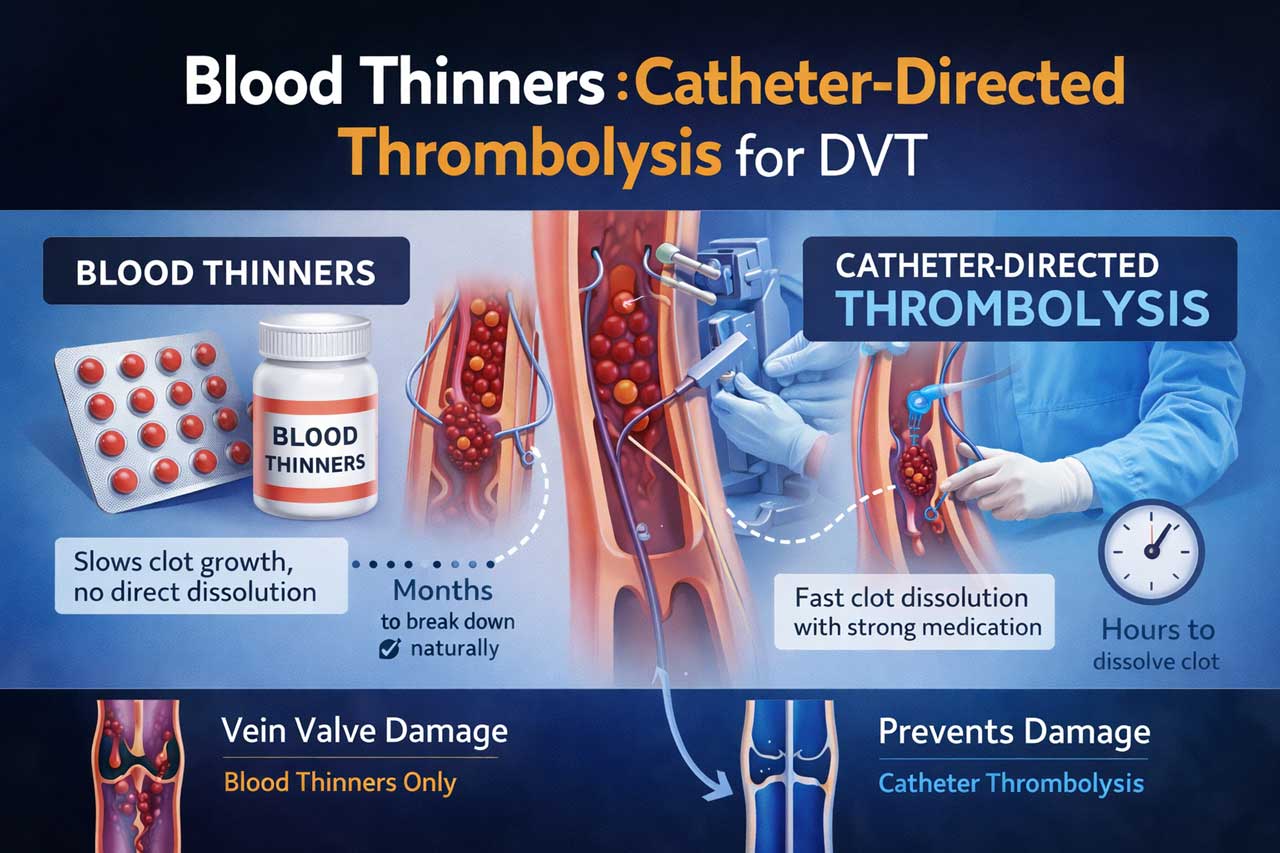
Blood thinners do not actually dissolve the clot. They only thin your blood to stop the current clot from getting bigger. They also help lower your pulmonary embolism risk. This is a dangerous condition where the clot breaks off and travels to your lungs.
Because the medicine does not destroy the blockage, your own body has to do the hard work. Your body has to slowly break down the old clot over many months. This slow process is why many patients complain about a blood clot in leg not going away on blood thinners. If the clot is very large, pills alone might not be enough to give you quick relief.
What is the fastest way to dissolve a blood clot in leg?
If pills take too long, you might be looking for alternatives to blood thinners for DVT. You want a solution that works right now. The answer to this problem is catheter-directed thrombolysis for DVT.
This is a highly advanced medical technique. Instead of just swallowing a pill and waiting, a doctor actively attacks the clot. We use a tiny, flexible tube to deliver powerful clot-busting medication (tPA) directly inside the blockage.
This process is known as deep vein clot dissolution. Because the strong medicine is sprayed right into the clot, it breaks down from the inside out. This happens in a matter of hours or days, rather than months.
Medical management vs catheter-directed thrombolysis
Let us closely look at CDT vs blood thinners to understand the differences. In the debate of anticoagulants vs thrombolysis, time and vein health are the biggest factors.
Pills take months to show full results. The CDT procedure for blood clots works much faster. But speed is not the only benefit. Another huge factor is Post-thrombotic syndrome (PTS) prevention.
PTS is a serious condition. If a big clot sits in your leg for months, it damages the tiny valves inside your veins. This damage causes permanent leg pain, dark skin color changes, and even open sores.
By actively clearing the vein quickly, CDT saves your delicate valves. This is why many experts consider it a superior chronic leg swelling and pain treatment.
How to remove blood clot in leg without surgery
You might be worried that active clot removal requires a big operation. You can relax. Today, we can remove blood clot in leg without surgery. We use modern minimally invasive clot removal techniques.
This relies entirely on the field of interventional radiology for DVT. We do not use scalpels. We do not make large cuts. Instead, we make a tiny pinhole in your skin. Using live X-ray guidance, we drive a tiny catheter directly to the clot. We then inject thrombolytic agent directly into the clot to loosen it up and then in the same sitting suck the softened clot through the same or different catheter. This may result in more than 90% of clot clearance in one sitting.
This approach is highly safe. You recover quickly and go home much sooner than you would after traditional open surgery.
Finding the Best Care in Delhi NCR
Finding the right doctor matters. If you need a skilled DVT doctor in Delhi, Dr. Akash Bansal offers world-class care. He is widely recognized as the best DVT specialist in Delhi NCR.
Our facility is fully equipped to perform catheter-directed thrombolysis in Delhi. We are known as the premier Vascular and interventional clinic Delhi residents trust for complex vascular issues. Finding a reliable vascular specialist in Delhi does not have to be stressful.
We serve patients from all across the region. Whether you are seeking urgent DVT treatment in Noida or need to consult an interventional radiologist in Gurgaon, our clinic doors are open. If you are searching online for an “interventional radiologist near me,” you can stop looking. Dr. Akash Bansal interventional radiologist provides compassionate, safe, and highly effective care to get you back on your feet.
Frequently Asked Questions
To help you fully understand your DVT treatment options, here are answers to common questions.
How long do blood thinners take to dissolve a clot? Blood thinners do not dissolve clots directly. Your body does the work naturally, which can take 3 to 6 months. If you want faster results, an interventional radiologist in delhi can explain active removal options during a consultation.
What is catheter-directed thrombolysis (CDT)? It is a highly targeted therapy to destroy clots fast. A doctor places a tiny catheter directly into the clot to release strong medicine. It is considered one of the best minimally invasive pinhole procedures available today.
When is CDT recommended over blood thinners for DVT? It is highly recommended for large, fresh clots, especially in the upper leg or pelvis. If you visit a minimally invasive surgery clinic delhi, they will check if you qualify. An interventional radiologist will look at your ultrasound scans to decide the safest path.
Can a blood clot in the leg be removed immediately? Yes. By using modern scarless procedures, doctors can often suck out or dissolve the clot in a matter of hours. Dr. Akash Bansal specializes in this kind of rapid, non-surgical relief.
What are the risks of leaving a DVT on blood thinners alone? The main risk is permanent vein valve damage, known as PTS. This leads to lifelong pain and swelling. An expert from a vascular and interventional clinic will often advise that active removal is much better for severe cases to protect your long-term mobility.
How does an interventional radiologist treat DVT? As a dedicated vascular specialist in delhi, they use real-time image guidance. Whether they are acting as an interventional oncologist for cancer-related blood clots, or treating standard DVT, the method is similar. An interventional radiologist in noida or an interventional radiologist in gurgaon will use a tiny catheter inside your blood vessels to clear the blockage. If you are searching for an interventional radiologist near me, these safe, image-guided methods are exactly what you will receive.
Disclaimer: The content provided in this blog is for educational and informational purposes only. It is not intended to be a substitute for professional medical advice, diagnosis, or treatment. Always seek the advice of a qualified healthcare provider or a vascular specialist like Dr. Akash Bansal with any questions you may have regarding a medical condition, symptoms, or treatment options. Never disregard professional medical advice or delay in seeking it because of something you have read on this website.