

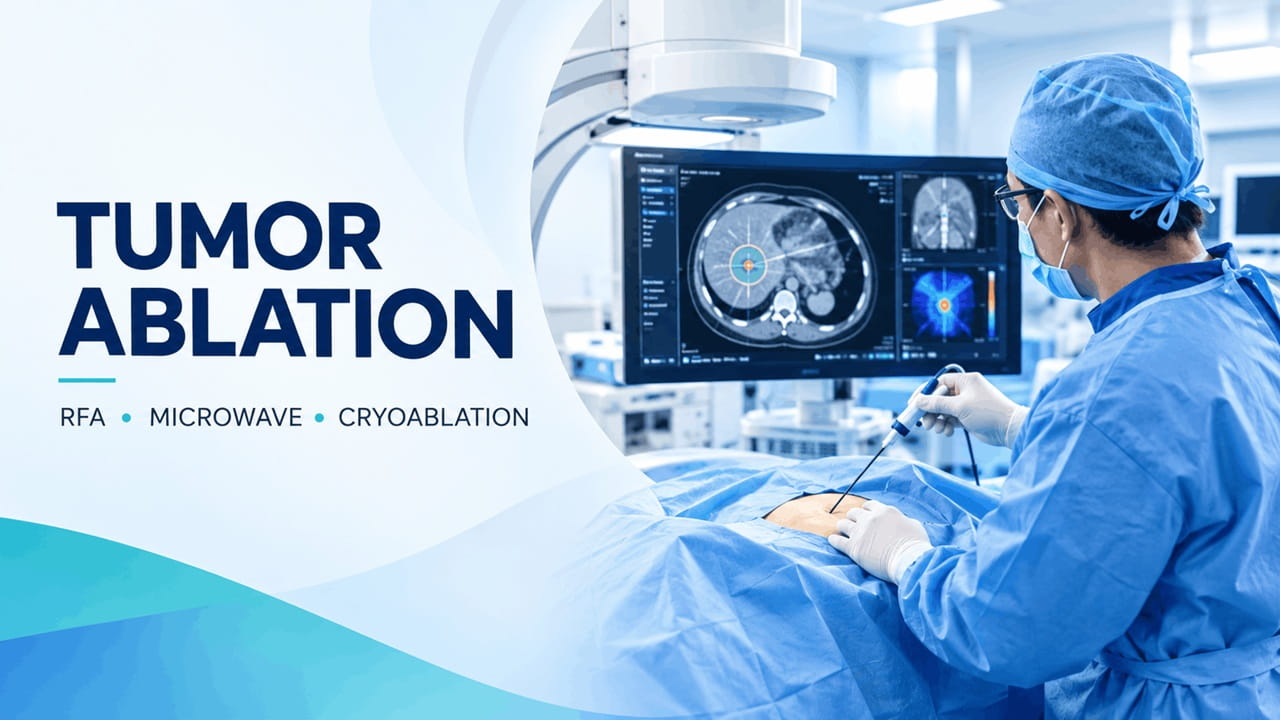
If your care team has mentioned “ablation” as a possible treatment for a tumor, it can be hard to know what that actually involves or why there seem to be three different versions of it. Tumor ablation is a family of minimally invasive, image-guided treatments that destroy tumor tissue directly, without open surgery, using a thin probe inserted through the skin. The three main types radiofrequency ablation (RFA), microwave ablation, and cryoablation all achieve a similar goal through different physical mechanisms, and none of them is universally “the best.” The right choice depends on the specific tumor being treated.
This article explains what tumor ablation is, how each technique works, and the factors that guide the choice between them.
A note before we start: tumor ablation is one option among several in cancer care, and its suitability depends on many individual factors. This article is educational and does not replace evaluation by your oncology and interventional radiology team.
What Is Tumor Ablation?
Tumor ablation is a percutaneous (through-the-skin) treatment that destroys tumor tissue in place, without removing it surgically. A thin needle-like probe is guided directly into the tumor using imaging typically ultrasound, CT, or MRI and energy is delivered through the probe to destroy the tumor cells.
It’s most often used for:
- Solid tumors that are relatively small and well-defined
- Patients who aren’t candidates for surgery, due to tumor location, other health conditions, or personal preference
- Tumors in organs such as the liver, kidney, lung, and bone, and in certain soft tissue tumors
- As part of a broader treatment plan alongside surgery, radiation, or systemic therapy for example, treating a tumor that recurs after other treatment, or combining ablation with other liver-directed therapies
Ablation is performed by an interventional radiologist or interventional oncologist, usually under local anesthesia with sedation, or occasionally general anesthesia depending on the tumor’s location and the patient’s needs.
How Does Tumor Ablation Work? Three Different Mechanisms
All three techniques destroy tumor cells by creating extreme temperatures at the tip of a probe placed inside the tumor but they get there in different ways, and each has situations where it tends to perform better.
Radiofrequency Ablation (RFA)
RFA uses high-frequency alternating electrical current, delivered through an electrode at the tip of the probe, to generate friction-based heat within the tumor tissue. Temperatures typically reach a level sufficient to destroy the tissue in a zone around the probe tip.
RFA is the most established and longest-used of the three techniques, with a large body of long-term data behind it, particularly for liver tumors.
A known limitation: RFA is more affected by nearby blood vessels than the other techniques. Flowing blood in an adjacent vessel can carry heat away from the target area sometimes called the “heat sink effect” which can reduce how completely a tumor near a blood vessel is treated.
Microwave Ablation (MWA)
Microwave ablation uses electromagnetic microwave energy, rather than electrical current, to agitate water molecules within the tissue and generate heat. This tends to produce higher temperatures, larger ablation zones, and faster treatment times compared with RFA, and it’s generally less affected by the heat sink effect near blood vessels.
Because of these properties, microwave ablation has become increasingly preferred for larger tumors or tumors located near blood vessels, in many centers, though RFA remains a well-established alternative in many of the same situations.
Cryoablation
Cryoablation works in the opposite direction instead of heat, it uses extreme cold. Argon gas circulated through the probe rapidly freezes the surrounding tissue, forming a visible “ice ball” that can be monitored on imaging during the procedure. Repeated freeze-thaw cycles cause the tumor cells to die.
A distinguishing feature of cryoablation is that the ice ball is directly visible on CT or MRI during the procedure, which allows for precise, real-time monitoring of the treatment zone an advantage in tumors located near sensitive structures like nerves or bowel, where precision matters most. Cryoablation is also generally reported to be less painful during and immediately after the procedure than heat-based methods, in part because freezing has a numbing effect on nearby tissue.
RFA vs Microwave Ablation vs Cryoablation: Side-by-Side Comparison
| RFA | Microwave Ablation | Cryoablation | |
| Mechanism | Heat via electrical current | Heat via microwave energy | Freezing via argon gas |
| Typical treatment time | Longer | Often faster | Moderate to longer, due to freeze-thaw cycles |
| Affected by nearby blood vessels (heat sink) | Yes, more so | Less affected | Not applicable different mechanism |
| Ablation zone size | Smaller, may need multiple placements for larger tumors | Often larger per session | Can be shaped and monitored precisely |
| Real-time visibility of treatment zone | Not directly visible on imaging | Not directly visible on imaging | Ice ball is directly visible on CT/MRI |
| Typical pain level | Moderate | Moderate | Often reported as lower |
| Common uses | Liver, kidney, bone, lung tumors | Liver, kidney, lung tumors, especially larger lesions | Kidney, bone, soft tissue, tumors near sensitive structures |
| Longest track record | Yes most established | Growing rapidly | Well established, especially in kidney and bone |
Across many studies comparing these techniques in different organs, results are genuinely mixed and often close between RFA and microwave ablation, with each showing an edge in certain settings for instance, several studies suggest microwave ablation performs better for larger tumors, while RFA and cryoablation have shown comparable or sometimes better local tumor control in select settings depending on tumor type. Cryoablation has shown particular strength for tumors located close to critical structures, where the visible ice ball allows for more precise treatment planning.
Which Ablation Technique Is Best?
This is the question everyone wants a simple answer to, and the honest one is: it depends, and no single technique is universally superior. The right choice is guided by a combination of factors your interventional radiologist and oncology team will assess together:
- Tumor type and organ some organs have more comparative data supporting one technique over another
- Tumor size larger tumors often favor microwave ablation’s bigger ablation zones
- Location relative to blood vessels tumors near vessels may respond better to microwave ablation or cryoablation, given the heat sink limitation of RFA
- Proximity to sensitive structures nerves, bowel, or the collecting system in the kidney may favor cryoablation, given its precise, visible treatment zone
- Number of tumors being treated in one session
- Patient factors, including how well a patient is expected to tolerate the procedure and any anesthesia considerations
- Local expertise and equipment availability
In many cases, more than one technique would be a reasonable option, and the choice comes down to the specific combination of these factors for that patient’s tumor which is exactly why this decision is made by a specialist team rather than a fixed rule.
Is Tumor Ablation Safe? What Are the Risks?
Tumor ablation is generally well tolerated, particularly compared with open surgery, but it does carry risks that vary somewhat by technique, tumor location, and organ involved:
- Pain or discomfort at the treatment site, usually temporary
- Bleeding or bruising at the needle insertion point
- A small risk of injury to nearby structures, depending on tumor location
- Infection, uncommon with proper technique
- Incomplete treatment of the tumor, particularly for larger or awkwardly positioned tumors, which may require a repeat procedure or an alternative approach
Your interventional radiologist will review your specific imaging and tumor characteristics to assess these risks for your individual case before the procedure.
What Is Recovery Like After Tumor Ablation?
Recovery is generally quicker than after surgical tumor removal:
- Most ablation procedures are outpatient or involve a single overnight stay, depending on the organ treated and the patient’s overall condition
- Mild soreness at the treatment site is common for a few days
- Most patients resume normal activities within about a week
- Follow-up imaging, typically CT or MRI, is scheduled in the following weeks to months to confirm the treatment was effective and to monitor for any recurrence
Frequently Asked Questions
What is the difference between RFA and microwave ablation? Both use heat to destroy tumor tissue, but RFA uses electrical current while microwave ablation uses electromagnetic energy. Microwave ablation generally creates larger ablation zones faster and is less affected by nearby blood vessels, while RFA has a longer track record of long-term data.
What is the difference between microwave ablation and cryoablation? Microwave ablation destroys tissue with heat, while cryoablation destroys tissue by freezing it. Cryoablation allows the treatment zone to be directly visualized on imaging during the procedure, which can be an advantage near sensitive structures, and is often associated with less procedural pain.
RFA vs microwave ablation vs cryoablation which is better? None is universally better. Each has situations where it tends to perform favorably microwave ablation for larger tumors or those near blood vessels, cryoablation for tumors near sensitive structures where precise visualization matters, and RFA as a well-established option with a long track record, particularly for smaller, well-positioned tumors.
Can tumors be treated without surgery? Yes. Tumor ablation is one of several non-surgical options for appropriately selected tumors, alongside treatments like TACE, TARE, radiation therapy, and systemic therapy, depending on the type and location of the tumor.
Is tumor ablation painful? Most procedures are performed under local anesthesia with sedation, or occasionally general anesthesia. Some post-procedure soreness is common, though cryoablation is often reported as less uncomfortable than heat-based methods due to the numbing effect of freezing.
What is recovery like after tumor ablation? Most patients go home the same day or after one night, with mild soreness for a few days and a return to normal activity within about a week, though this varies by organ and individual case.
Can tumor ablation be repeated? Yes. If follow-up imaging shows the tumor wasn’t fully treated, or if a new tumor develops, ablation can often be repeated, or an alternative approach may be considered.
Does tumor ablation destroy the entire tumor? The goal of ablation is complete destruction of the treated tumor tissue, and this is achieved in the majority of appropriately selected cases, though success depends on tumor size, location, and technique. Follow-up imaging is used to confirm treatment response, and outcomes vary by individual case.
How is the right ablation technique selected? Your interventional radiologist and oncology team review tumor size, location, organ involved, proximity to blood vessels or sensitive structures, and your overall health to recommend the most appropriate technique for your specific case.
Talk to an Interventional Radiologist
If ablation has come up as an option in your care, understanding how RFA, microwave ablation, and cryoablation differ can help you have a more informed conversation about which approach fits your specific tumor.
Dr. Akash Bansal, an interventional radiologist, evaluates each tumor individually reviewing size, location, and imaging to determine which ablation technique, if any, is most appropriate, using minimally invasive, image-guided procedures performed at a vascular and interventional clinic. If tumor ablation has been suggested as part of your treatment plan, a consultation can help clarify which technique best fits your case.
Disclaimer:- This article is for general informational purposes and does not replace evaluation by a qualified oncology team. The choice of ablation technique, or whether ablation is appropriate at all, should always be made in consultation with your treating physicians based on your specific diagnosis and imaging.