
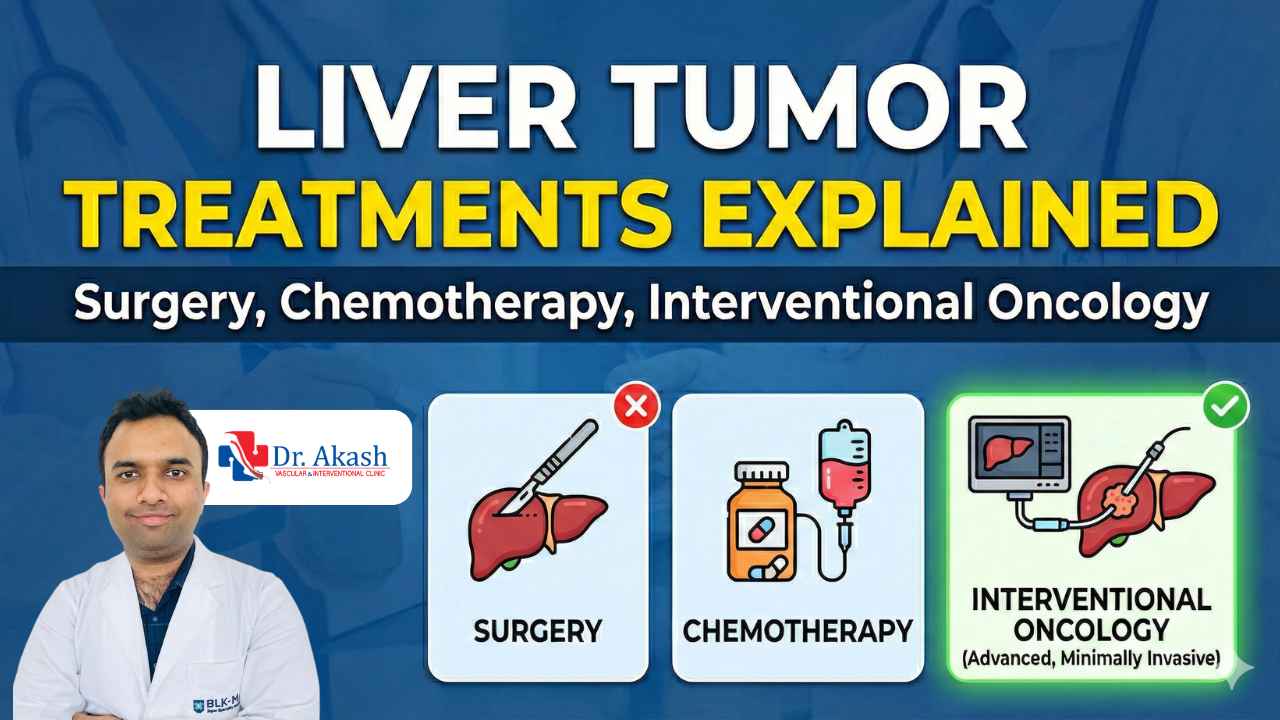
Liver Tumor Treatments Explained: Surgery, Chemotherapy, and Interventional Oncology
Hearing the words "liver tumor" can feel like your whole world has stopped. Whether you have just been diagnosed or are helping a loved one research their options, it is completely normal to feel overwhelmed. You likely have dozens of questions about what comes next. The most important thing to know right now is this: medical science has evolved incredibly fast, and you have more options today than ever before.
In the past, patients thought that risky open surgery was the only way to treat a liver mass. Today, a liver tumor treatment plan can involve a combination of therapies, many of which do not require a single surgical cut.
At Dr. Akash Bansal Vascular & Interventional Clinic, we believe that informed patients make the best decisions about their health. In this comprehensive guide, we will break down the different liver cancer treatment options, explaining everything in simple, everyday English. From traditional surgery to the latest breakthroughs in interventional oncology liver cancer care, here is everything you need to know.
Understanding Your Diagnosis: Types of Liver Tumors
Before discussing the treatments, it helps to understand what kind of tumor we are dealing with. Liver tumors are generally divided into benign (non-cancerous) and malignant (cancerous) growths.
1. Primary Liver Cancer: This is cancer that starts inside the liver. The most common type is Hepatocellular Carcinoma (HCC). Therefore, finding the right Hepatocellular carcinoma (HCC) treatment is a major focus for liver specialists. Another less common type starts in the bile ducts, requiring specific Cholangiocarcinoma treatment options.
2. Secondary Liver Cancer: Often, cancer starts in another part of the body (like the colon, breast, or lungs) and spreads to the liver. This is called liver metastasis. In these cases, liver metastasis treatment (Secondary liver cancer) focuses on controlling the spread and extending the patient's quality of life.
3. Benign Liver Tumors: Not all tumors are cancer. Some people develop non-cancerous growths. Finding the right benign liver tumor treatment is still important if the tumor grows large enough to cause pain. A common example is a hemangioma, and liver hemangioma treatment is often very straightforward and minimally invasive.
No matter the type, modern medicine offers various liver cancer modalities to manage the condition.
Traditional Surgical Options
When looking for a treatment for liver tumors, surgery is often the first thing that comes to mind. If a tumor is caught early and the rest of the liver is healthy, surgery can be highly effective.
Liver Resection Surgery
Also known as a hepatectomy for liver tumor, this procedure involves a surgeon physically cutting out the tumor along with a small margin of healthy tissue around it. Because the liver has an amazing ability to regenerate (grow back), removing a portion of it is possible. However, liver resection surgery is a major operation. It requires a hospital stay, a significant recovery period, and is only an option if the tumor is in a safe location to operate on.
Liver Transplant
In some cases where the liver is severely damaged by cirrhosis or there are multiple small tumors, a liver transplant for liver cancer might be considered. This involves removing the entire diseased liver and replacing it with a healthy liver from a donor. While it can be a cure, the waiting list for donor organs is long, and the surgery itself is highly complex.
Systemic Treatments: Chemotherapy and Targeted Therapy
If surgery is not an option—perhaps because the tumors are too large, there are too many of them, or they have spread to other organs—doctors often turn to systemic medications. "Systemic" means the medicine travels through your entire bloodstream to fight cancer cells everywhere.
Chemotherapy
Traditional chemotherapy for liver cancer uses strong drugs to kill fast-growing cancer cells. While it can slow down the disease, standard chemotherapy injected into a vein is sometimes less effective for primary liver cancer than it is for other cancers, and it often comes with tough side effects like nausea and fatigue.
Targeted and Systemic Therapy
Medical advancements have brought us targeted therapy liver cancer drugs. Instead of attacking all fast-growing cells, these drugs target specific weaknesses in the cancer cells themselves, stopping them from growing new blood vessels. This type of systemic therapy for HCC has become a vital part of comprehensive Hepatocellular carcinoma (HCC) modalities, offering hope to patients with advanced stages of the disease.
The Game Changer: Interventional Oncology
What if you could treat a liver tumor without making a large incision, without removing the organ, and without the harsh side effects of full-body chemotherapy? This is the promise of interventional oncology, a rapidly growing field of medicine.
An interventional radiologist is a highly specialized doctor who uses advanced imaging (like X-rays, ultrasounds, and CT scans) to see inside your body and guide tiny instruments to the exact site of the disease. This allows us to perform minimally invasive pinhole procedures that target the tumor directly from the inside.
At the vascular and interventional clinic, we focus heavily on non-surgical liver tumor treatment. These scarless procedures mean less pain, no large surgical wounds, and a much faster return to your normal life.
Here are the most effective minimally invasive options available today.
1. Image-Guided Tumor Ablation (Burning or Freezing the Tumor)
Ablation means to destroy. Image-guided liver tumor ablation involves inserting a needle-like probe directly through the skin into the liver tumor, guided by ultrasound or CT scans. Once inside the tumor, we destroy it.
- Radiofrequency ablation (RFA) liver cancer: This technique uses electrical energy to heat the probe, essentially cooking and killing the cancer cells.
- Microwave ablation (MWA) liver tumor: Similar to RFA, this uses electromagnetic waves (like your kitchen microwave) to create intense heat. MWA is often faster and can treat slightly larger tumors more effectively.
Ablation is a fantastic minimally invasive liver cancer treatment for patients with small tumors (<5 cm) with equivalent results to open surgery.
2. Embolization Techniques (Cutting off the Blood Supply)
Tumors are hungry. They need a constant supply of blood to grow. Embolization for liver cancer works by navigating a tiny tube (a catheter) through your blood vessels directly to the artery feeding the tumor. Once there, we block the blood supply, starving the tumor to death.
- TACE procedure for liver cancer (Transarterial Chemoembolization): In this procedure, we deliver a high dose of chemotherapy directly inside the tumor. Immediately after, we block the blood vessel. This traps the chemotherapy inside the tumor where it is needed most, while preventing the toxic drugs from circulating through the rest of your body.
- TARE procedure liver cancer (Transarterial Radioembolization / Y90): Instead of chemotherapy, TARE uses tiny glass or resin beads filled with radioactive isotopes (Yttrium-90). These radioactive beads lodge inside the tumor's blood vessels, delivering targeted radiation from the inside out, while sparing the healthy liver tissue around it.
These embolization techniques are highly effective for shrinking tumors and are a cornerstone of modern non-surgical liver cancer treatment in Delhi.
Why Choose Dr. Akash Bansal for Your Treatment?
If you are looking for an interventional radiologist near me, experience and precision are the most important factors. Dr. Akash Bansal is a leading interventional oncologist and a dedicated vascular specialist in delhi.
Our facility is recognized as a premier minimally invasive surgery clinic delhi, offering world-class care without the need for traditional open surgery. Whether you need a Liver ablation doctor in Delhi NCR or are specifically looking for the TACE procedure in Delhi, our team brings global expertise right to your doorstep.
Patients travel from all over to see our specialists. Whether you are looking for an interventional radiologist in noida, an interventional radiologist in gurgaon, or the Best interventional oncologist in Delhi, Dr. Akash Bansal interventional radiologist provides compassionate, cutting-edge care tailored to your exact anatomy. We are proud to be your trusted Interventional oncology clinic Delhi and a leading Liver tumor specialist in New Delhi.
Frequently Asked Questions (FAQs)
When dealing with a new diagnosis, it is natural to have many questions. Here are the answers to some of the most common questions our patients ask.
1. Can a liver tumor be cured without surgery?
Yes. For small tumors, especially those caught early, minimally invasive treatments like Microwave Ablation (MWA) or Radiofrequency Ablation (RFA) can completely destroy the tumor, offering a cure without the need for traditional open surgery.
2. What is the difference between TACE and TARE?
Both are embolization procedures that target the blood supply of the tumor using a catheter. The main difference is the "payload" they deliver. TACE (Transarterial Chemoembolization) delivers chemotherapy drugs directly into the tumor. TARE (Transarterial Radioembolization) delivers tiny radioactive beads to kill the tumor with targeted radiation.
3. How does microwave ablation work for liver cancer?
During Microwave Ablation (MWA), an interventional radiologist inserts a thin needle directly into the liver tumor through the skin. Electromagnetic waves are sent through the needle, creating intense heat that cooks and destroys the cancer cells instantly, while leaving the surrounding healthy liver tissue unharmed.
4. What is the recovery time for TACE procedure?
Because TACE is performed through a tiny pinhole (usually in the wrist or groin), recovery is very fast. Most patients stay in the hospital for just one night for observation and can return to their normal, light activities within just a few days. You may experience mild fatigue or a low-grade fever for a few days, which is perfectly normal.
5. Is liver ablation safe?
Yes, liver ablation is considered a very safe and highly effective procedure. Because it is guided by real-time imaging (like ultrasound or CT scans), the doctor has extreme precision. It carries a much lower risk of bleeding, infection, and complications compared to traditional open liver surgery.
6. When is chemotherapy used for liver tumors?
Traditional, full-body chemotherapy is generally used when liver cancer has spread to other parts of the body, or if the tumors cannot be treated with surgery or localized treatments like ablation and embolization. However, targeted chemotherapy delivered directly to the liver (like in the TACE procedure) is used very frequently with great success.
7. Who is a candidate for liver tumor embolization?
Embolization (like TACE or TARE) is usually recommended for patients who have tumors that are too large or too numerous to be treated with surgery or ablation, but where the cancer has not spread outside the liver. It is an excellent option for patients who want to shrink their tumors to relieve symptoms or to potentially qualify for a liver transplant later on.
Take the Next Step Toward Healing
A liver tumor diagnosis is a life-changing event, but it does not mean you are out of options. With the rise of interventional oncology, we can treat complex tumors using highly targeted, minimally invasive pinhole procedures that respect your body and speed up your recovery.
You don't have to face this alone. If you have been told surgery is your only option, or if you simply want to explore safer, non-surgical alternatives, we are here to help.
Contact Dr. Akash Bansal Vascular & Interventional Clinic today to schedule a comprehensive consultation. Let us help you find the safest and most effective treatment plan for your unique journey.